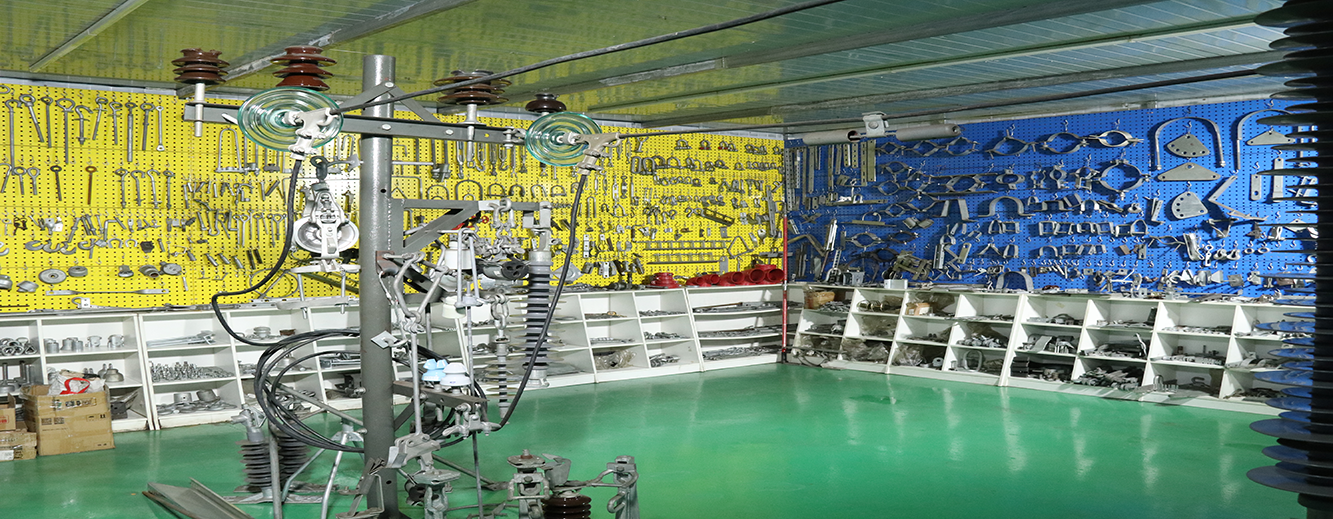
Pole line hardware fittings are the mechanical components used to construct, assemble, support, and maintain overhead power distribution and transmission lines on utility poles. They form the physical backbone of every overhead line system — connecting conductors to insulators, securing guy wires to anchor rods, mounting cross arms to poles, and providing the structural fastening at every node of the pole line assembly.
While large components like insulators, cross arms, and strain clamps tend to receive the most specification attention, it is the pole line hardware fittings — the eye nuts, pole clamps, thimble anchor rods, and linking hardware — that determine whether the entire assembly holds under load. A single undersized eye nut or a poorly galvanized pole clamp can compromise an otherwise sound overhead line installation.
Hebei Yipeng manufactures a comprehensive range of pole line hardware fittings for distribution networks at 11kV, 22kV, and 33kV, as well as transmission infrastructure at higher voltages. All products are hot-dip galvanized to ISO 1461, manufactured from forged or cast carbon steel, and supplied with full material and quality documentation to meet the requirements of EPC contractors and utility procurement teams worldwide.
All eye nuts are forged from carbon steel (Q235B equivalent), hot-dip galvanized to ISO 1461 (zinc coating ≥85 μm), and manufactured to ANSI C135 dimensional standards. Strength grade matches the bolt or rod with which they are used.
Anchor rod sizes range from 5/8" (16mm) to 1-1/4" (32mm) diameter, covering the full range of distribution and light transmission guying applications.
Pole clamps are used across distribution networks to mount secondary equipment, service brackets, telecommunications hardware, and street light arms without compromising the structural integrity of the pole.
In addition to the above pole line hardware fittings, Yipeng supplies the complete range of structural linking hardware used to connect the sub-assemblies of an overhead line string.
Yipeng overhead line fittings are designed and tested to comply with the following international and national standards:
IEC 61284 — Overhead lines: Requirements and tests for fittings
IEC 61952 — Insulators for overhead lines: Composite line post insulators
GB/T 2315 — China national standard for overhead line hardware
BS 3288 — UK specification for insulator and conductor fittings
ANSI/IEEE C135 series — North American distribution hardware standards
ISO 1461 — Hot-dip galvanizing on fabricated iron and steel articles
Factory certifications:
ISO 9001:2015 Quality Management System
CE Declaration of Conformity (available for relevant product lines)
SGS and BV third-party pre-shipment inspection accepted
Copies of test reports, material certificates, and third-party inspection reports are available upon request for tender packages and EPC project submissions.
Incorrect fitting selection is one of the most common causes of overhead line failures. Use this checklist when specifying overhead line fittings for a project:
Step 1 — Define the electrical systemVoltage level determines insulator class, creepage distance, and indirectly the mechanical class of fittings required. A 33kV distribution line and a 220kV transmission line use completely different hardware series.
Step 2 — Identify the conductor type and cross-sectionAll clamp fittings — suspension and strain — are dimensioned to specific conductor outer diameters. Specify conductor type (AAC, AAAC, ACSR, copper), cross-section (mm²), and outer diameter (mm) to get correctly matched overhead line fittings.
Step 3 — Determine mechanical loadingWind span, weight span, conductor tension at every structure, and maximum design load — these numbers drive the SWL (Safe Working Load) requirement for every fitting in the string assembly. Never substitute a lower-rated fitting.
Step 4 — Assess environmental conditionsCoastal, industrial-pollution, and high-humidity zones require higher zinc coating specifications (≥100μm), stainless steel R-pins, and potentially aluminum alloy bodies instead of cast iron for suspension clamps.
Step 5 — Confirm connection interface dimensionsLink fittings, suspension clamps, and strain clamps must have matching ball/socket dimensions or clevis tongue dimensions to assemble correctly. Reference IEC 61284 or GB/T 2315 dimension series when mixing hardware from different components.
Step 6 — Verify standard complianceFor international tenders, confirm which national or international standard governs — IEC, BS, ANSI, or local utility specifications. Yipeng can provide products tested and documented to the required standard.
Q: What is the difference between overhead line fittings, overhead line hardware, and overhead line accessories?
A:These three terms are used interchangeably in the industry. All refer to the same category of mechanical and electrical components — clamps, link fittings, protective devices, and mounting hardware — used in constructing overhead power lines.
Q: What standards do your overhead line fittings comply with?
A:Our standard range complies with GB/T 2315 (China) and IEC 61284 (international). Products can be manufactured and tested to BS 3288 or ANSI/IEEE C135 with advance notice. We provide test reports for all compliance claims.
Q: Can you supply a complete fitting package for a substation or line project?
A:Yes. For EPC contractors and utilities, Yipeng can supply a complete bill of materials covering suspension clamps, strain clamps, link fittings, vibration dampers, insulators, cross arms, and fasteners from a single purchase order. This simplifies logistics, reduces vendor qualification overhead, and ensures dimensional compatibility across the hardware string.
Q: What is the minimum order quantity for overhead line fittings?
A:For standard products, MOQ is typically 100–500 pieces per product code depending on item complexity. Sample orders of 5–10 pieces are accepted for first-time clients or new project evaluation. Mixed-SKU container orders are welcomed.
Q: Do you offer hot-dip galvanizing? What zinc thickness standard do you use?
A:All ferrous overhead line fittings are hot-dip galvanized to ISO 1461 as standard, with a minimum zinc coating of 85μm on fitting bodies. For high-corrosion environments, 100μm or higher specifications are available upon request.
Q: Can I use your overhead line fittings with conductors from other manufacturers?
A:Yes — overhead line fittings are dimension-standardized, not conductor-brand-specific. Provide the conductor outer diameter and type, and we will confirm compatibility or recommend the correct product variant.
Whether you need a single product sample or a full project BOM, Yipeng responds within 1 business day with pricing, available test documentation, and delivery timeline.Contact Us Now
+86 319 878 9350
+86 156 1304 7999
+86 319 878 9350
NanYan, DongHuan Road, Shahe, Hebei China
Copyright © Hebei Yipeng Line Equipment Co., Ltd. All Rights Reserved. | Sitemap Powered By