Insulator Pin / Spindle
Inquire NowNone

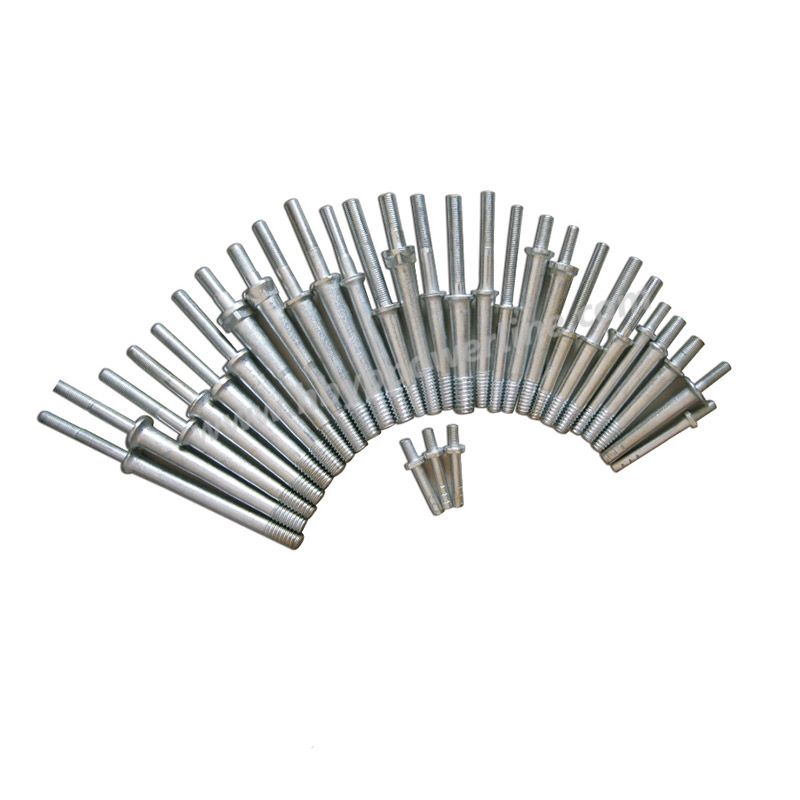
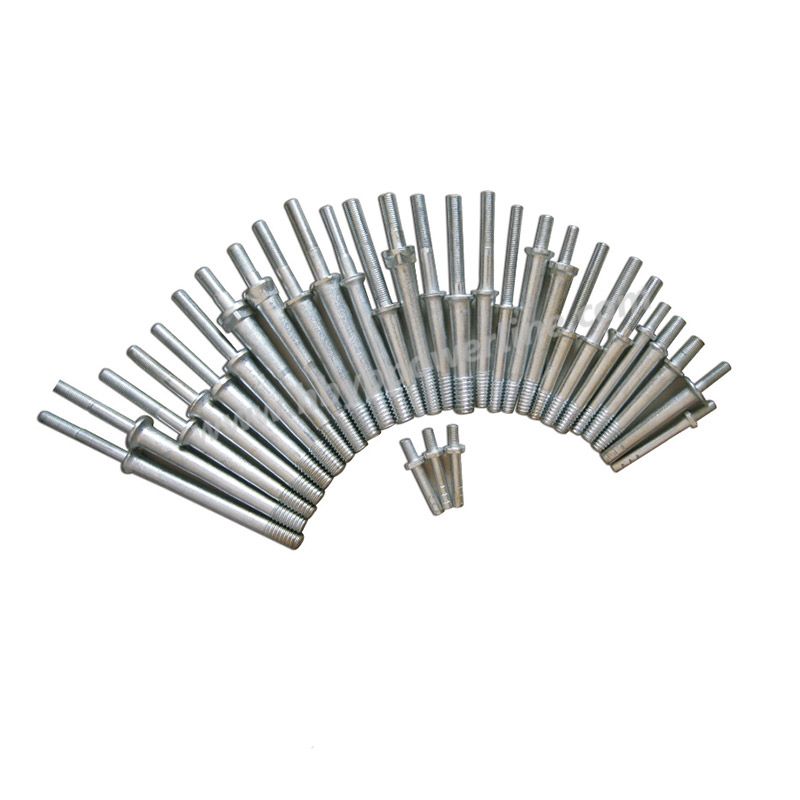
An insulator pin spindle — also called an insulator pin, pole top pin, or cross arm spindle — is a forged steel mounting component that connects a pin-type insulator to a steel cross arm or wooden cross arm on an overhead distribution or transmission pole. It serves as the mechanical interface between the supporting structure and the insulating body, carrying the vertical and lateral loads imposed by the conductor while maintaining full electrical separation.
In a standard overhead line assembly, the insulator pin spindle is bolted through the cross arm using a nut, washer, and lock nut. The pin insulator (porcelain, glass, or composite) is then threaded onto the spindle head, and the conductor is tied into the insulator groove with a tie wire or preformed tie. The entire assembly provides both the mechanical support and the electrical insulation needed to safely carry 11kV–33kV distribution voltages.
It is important to distinguish between the insulator pin spindle (the steel mounting hardware) and the pin insulator itself (the ceramic or polymer insulating body). The two are used together as a system — Yipeng supplies both components, allowing buyers to source a complete, matched assembly from a single factory.
| Parameter | Specification |
|---|---|
| Product Name | Insulator Pin Spindle / Pole Top Pin |
| Material | Forged mild steel (carbon steel Q235 / S235 equivalent) |
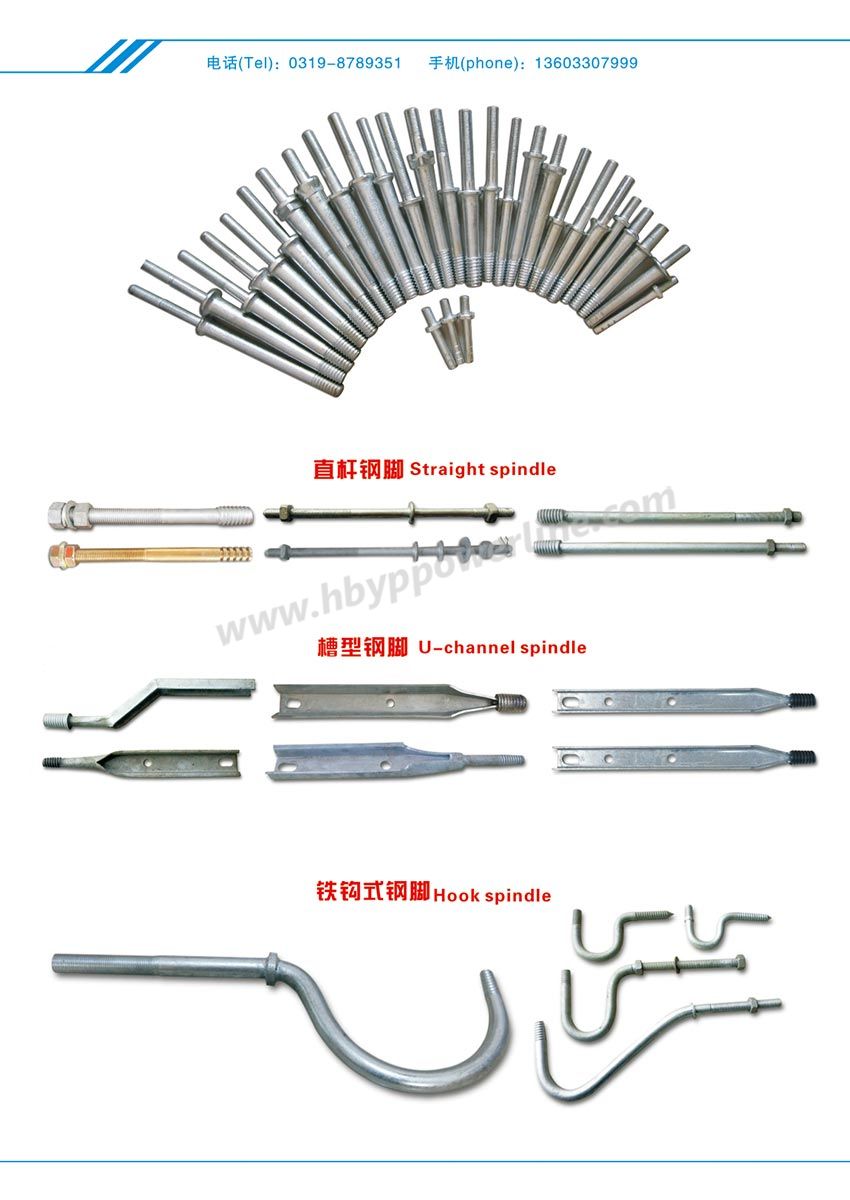
| Head Types | Lead head, Nylon head, Small steel head, Large steel head |
| Thread Standard | BS 137 Part 2 (lead/nylon); ANSI C135 (steel head) |
| Applicable Voltage | 11kV, 22kV, 33kV distribution lines |
| Shank Length | Standard 18" (457mm) and 20" (508mm); custom lengths available |
| Shank Diameter | Typically Ø 16mm–25mm depending on cross arm hole size |
| Lead Thread Size | 1" BSP or 1-3/8" BSP (to buyer specification) |
| Mounting Hardware | Supplied with square washer, square nut, and locknut as standard |
| Surface Finish | Hot-dip galvanization (HDG) per ISO 1461 / BS 729 |
| Zinc Coating Thickness | ≥ 85 μm average; ≥ 70 μm local minimum |
| Operating Temperature | -40°C to +85°C |
| Applicable Standard | IEC, BS 137 Part 2, ANSI C135, GB/T, or per client specification |
| Certification | ISO 9001; third-party inspection (SGS, BV) available on request |
Custom dimensions and hole patterns available. Yipeng supports both OEM production from client drawings and reverse-engineering from samples. Lead time for standard stock items: 15–20 days; custom orders: 20–30 days.
All Yipeng insulator pin spindles are manufactured from forged mild steel — not cast iron or machined bar stock. The forging process aligns the grain structure of the steel along the length of the shank, resulting in:
Superior tensile and bending strength in the load-bearing direction
Higher impact resistance than cast alternatives
More consistent dimensional tolerances across production batches
Reduced risk of internal void defects that can cause unpredictable failures under load
Steel grade used is Q235B (equivalent to S235JR / ASTM A36), with mechanical properties tested on incoming material to verify yield strength ≥ 235 MPa and tensile strength ≥ 375 MPa.
Every insulator pin spindle from Yipeng is finished by full-immersion hot-dip galvanization, not electroplating or spray coating. The HDG process bonds a zinc-iron alloy layer metallurgically to the steel substrate, delivering:
Long-term atmospheric corrosion protection — typically 25–40 years in rural/suburban environments
Complete coverage of all surfaces including thread roots, weld fillets, and cut shank ends
Sacrificial cathodic protection of any exposed base metal at abrasion points
Compliance with ISO 1461 and BS EN ISO 1461; zinc coating thickness verified per ISO 2178 on every production batch
Spindles supplied for lead-head configurations undergo the HDG process prior to lead casting. This sequencing ensures the shank and mounting section are fully protected before the insulator interface is formed.
Yipeng's insulator pin spindles are used across a wide range of overhead network infrastructure:
11kV medium-voltage distribution lines — the most common application; pin type insulators with lead-head spindles are the standard solution for tangent (straight-line) pole positions in rural and urban distribution networks across Africa, Asia, the Middle East, and the Pacific
33kV sub-transmission lines — larger spindle configurations for 33kV insulators at higher mechanical loads and longer span distances
Wooden pole distribution networks — hook-base and channel-base spindle variants for mounting to timber cross arms using coach screws or U-bolts
Steel cross arm assemblies — standard shank-type insulator pin spindles bolted through pre-drilled cross arm holes, the most common configuration in new construction
Concrete and steel pole lines — extended shank and pole-top-pin configurations for direct mounting at the pole head without a separate cross arm
Railway traction lines — heavy-duty spindle assemblies for supporting insulation on electrified rail structures
Telecom pole lines — lightweight spindle variants for supporting lower-voltage insulators and cable fixings on joint-use poles
Yipeng spindles have been exported to overhead line projects in sub-Saharan Africa, Southeast Asia, the Middle East, South America, and Europe, configured to local utility specifications including BS 137, IEC 60305, and custom utility standards.
Understanding the installation sequence helps procurement teams specify the correct configuration:
Step 1 — Cross Arm Hole AlignmentThe cross arm has pre-drilled holes positioned to achieve the required conductor spacing. The insulator pin spindle shank passes through one of these holes from below.
Step 2 — Mounting HardwareA square washer is placed over the shank below the cross arm surface. The square nut is threaded onto the shank and tightened against the washer to clamp the spindle securely to the cross arm. A locknut above the square nut prevents loosening from vibration.
Step 3 — Insulator EngagementThe pin insulator is rotated clockwise onto the spindle head, engaging the lead, nylon, or steel thread. For BS-standard insulators with zinc thimbles, the lead thread on the spindle forms a self-seating engagement with the cemented thimble inside the insulator base.
Step 4 — Conductor InstallationThe conductor is laid into the top or side groove of the pin insulator and secured with a preformed tie wire or hand-tied wire. The completed assembly holds the conductor in position while providing the specified electrical clearance from the grounded cross arm.
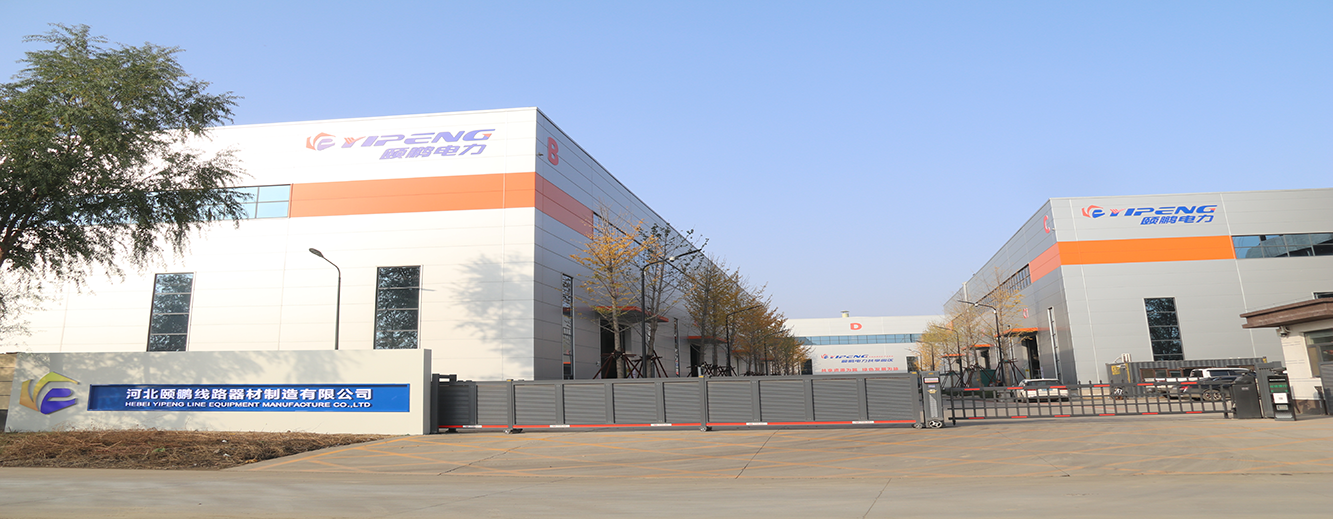
Hebei Yipeng Line Equipment Co., Ltd. manufactures overhead line hardware including insulator pin spindles, cross arms, stay rods, strain clamps, and insulators from our production facility in Shahe, Hebei — one of China's most concentrated regions for power line hardware manufacturing.
Factory with ISO 9001 Certification — Controlled production processes with documented inspection at each manufacturing stage, from incoming forging inspection to final HDG coating verification before shipment.
Complete Pin Assembly Supply — Yipeng manufactures both the insulator pin spindle hardware and the matching porcelain pin insulators. Source the complete assembly — spindle, insulator, nuts, and washers — from one factory, eliminating compatibility risk and simplifying import documentation.
Full Head Type Range — Lead head, nylon head, small steel head, and large steel head spindles in both 11kV and 33kV configurations, plus custom variants. We hold tooling for the most common BS and ANSI configurations and can produce new designs from buyer drawings.
Proven HDG Quality — All spindles hot-dip galvanized to ISO 1461 / BS 729. Coating thickness records maintained per batch. Third-party inspection (SGS, Bureau Veritas) welcomed and arranged at buyer's request.
Experienced Exporter — Yipeng has supplied overhead line hardware to 30+ countries. We are familiar with L/C, T/T, and project-based procurement terms; can provide full export documentation including CO, packing list, test reports, and mill certificates.
Responsive Technical Support — Submit drawings, samples, or utility specifications and receive a DFM review and quotation within 1 business day. Pre-production samples available before mass production.
Q: What is the difference between a lead head and a nylon head insulator pin spindle?
A: Both serve the same function — engaging the threaded socket inside a pin insulator. Lead head spindles use a cast lead alloy thread that conforms precisely to the insulator socket and is the traditional BS 137 specification. Nylon head spindles use an engineered polymer thread and are preferred in markets with restrictions on lead materials or where a lead-free supply chain is required. Both are fully compatible with standard BS-type pin insulators fitted with zinc thimbles.
Q: What voltage levels are your insulator pin spindles designed for?
A: Our standard range covers 11kV and 33kV distribution applications, which are the most common globally. For voltages above 33kV, pin-type insulator systems give way to suspension and strain insulator configurations, so insulator pin spindles are not typically used above 33kV. Contact us if you have a specific voltage requirement outside this range.
Q: Can you supply the insulator pin spindle together with the matching pin insulator?
A: Yes. Yipeng manufactures porcelain pin insulators (P-11, P-33, and equivalent types) that are dimensionally matched to our spindle head configurations. We can supply complete assembly sets comprising spindle, insulator, tie wire, washer, nut, and locknut — reducing your sourcing steps and ensuring compatibility.
Q: What is your standard packaging for export?
A: Insulator pin spindles are typically packed in double-layer woven bags or wooden crates depending on the destination port and buyer preference. Each package is labeled with product code, quantity, batch number, and country of origin to meet customs requirements.
Q: What is the minimum order quantity (MOQ)?
A: For standard lead-head and nylon-head spindle configurations, MOQ is typically 500–1,000 pieces per type. For fully custom designs or small initial orders, MOQ is discussed on a project basis. Sample orders are accepted.
Q: Do you comply with BS 729 / ISO 1461 for the galvanizing?
A: Yes. All insulator pin spindles are hot-dip galvanized to BS EN ISO 1461 (equivalent to the older BS 729 standard). Zinc coating thickness is measured per ISO 2178 on every production batch, and records are available for quality audit. Third-party coating inspection can be arranged with SGS, BV, or other nominated inspection agencies.

+86 319 878 9350
+86 156 1304 7999
+86 319 878 9350
NanYan, DongHuan Road, Shahe, Hebei China
Copyright © Hebei Yipeng Line Equipment Co., Ltd. All Rights Reserved. | Sitemap Powered By